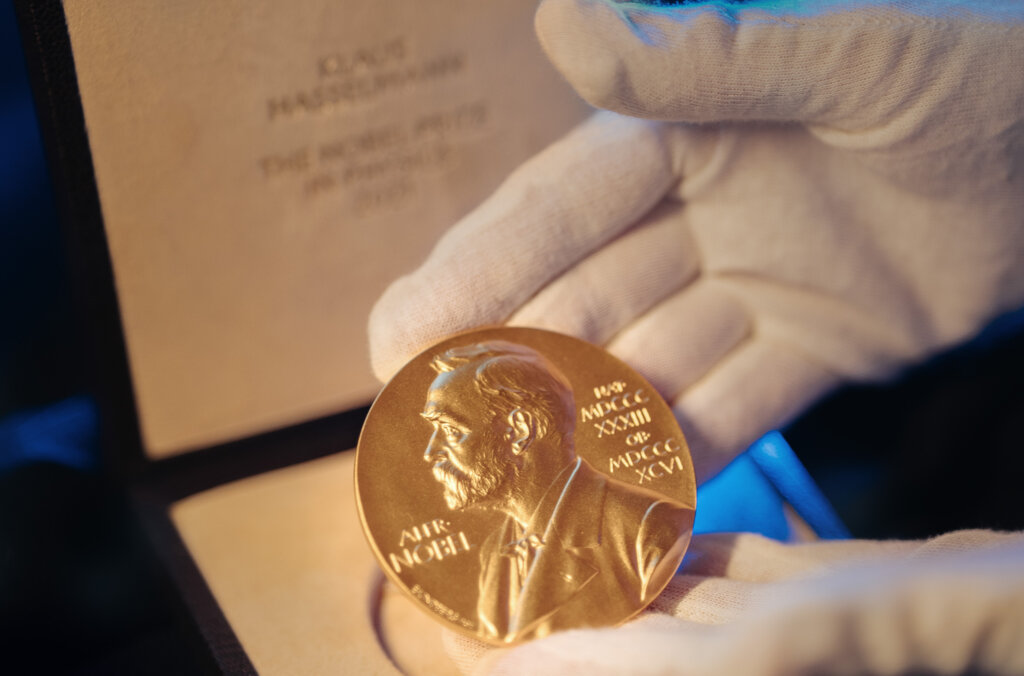
We live stream the announcements of this year’s Nobel Prizes daily from 5–12 October. The broadcast takes place from the heart of the museum, and there is no seating available.
Dates and times
Nobel Prize in Physiologi or Medicine
Announced on Monday 5 October, at the earliest at 11:30.
Read more about the medicine prize
Nobel Prize in Physics
Announced on Tuesday 6 October, at the earliest at 11:45.
Read more about the physics prize
Nobel Prize in Chemistry
Announced on Wednesday 7 October, at the earliest at 11:45.
Read more about the chemistry prize
Nobel Prize in Literature
Announced on Thursday 8 October, at the earliest at 13:00.
Read more about the Nobel Prize in Literature
Nobel Peace Prize
Announced on Friday 9 October, no earlier than 11.00.
Read more about the peace prize
Sveriges Riksbank Prize in Economic Sciences in Memory of Alfred Nobel
Announced on Monday 12 October, no earlier than 11:45.
Read more about the prize in economic sciences.

NOBEL CALLING
STOCKHOLM
5–12 October
About the programme
Date
5–12 October 2026
Location
Nobel Prize Museum
Language
Swedish and English
Admission
Included in the museum admission ticket
Nobel Prize in Physiology or Medicine
Alfred Nobel had a great interest in medical research. In the early 1890s, he invited the Swedish physiologist Jöns Johansson to his laboratory in France. They had become acquainted with each other at Karolinska Institutet, and together they did medical research.
Physiology or Medicine was the third prize category that Nobel mentioned in his will. Since 1901, the medicine laureates have been selected by the Nobel Assembly at Karolinska Institutet.
Nobel Prize in Physics
Physics was the prize category that Alfred Nobel mentioned first in his 1895 will. In the late nineteenth century, many scientists considered physics to be the foremost of the sciences ‒ perhaps even Nobel himself.
Nobel’s own research was closely related to physics. Since 1901, Nobel Prize laureates in physics have been selected by the Royal Swedish Academy of Sciences.
Nobel Prize in Chemistry
Chemistry was the most important science for Alfred Nobel’s own work. The development of his inventions, as well as the industrial processes he used, were based on chemistry. This was the second prize category that Nobel mentioned in his will.
Since 1901, Nobel Prize laureates in chemistry have been selected by the Royal Swedish Academy of Sciences.
Nobel Prize in Literature
Alfred Nobel had a broad interest in culture. During his early youth, he developed a passion for literature that lasted throughout his life.
Nobel’s library consisted of a wide selection of books in many languages, and he also wrote fiction himself. Literature was the fourth prize category that Nobel mentioned in his will.
Since 1901, Nobel Prize laureates in literature have been selected by the Swedish Academy.
Nobel Peace Prize
Alfred Nobel showed a great interest in social issues and the peace movement. His acquaintanceship with Bertha von Suttner, who was a driving force in the international peace movement in Europe and was later awarded the Peace Prize, influenced his view of peace.
Peace was the fifth and final prize category that Nobel mentioned in his will. Since 1901, Nobel Peace Prize laureates have been selected by a committee elected by the Norwegian Parliament (Storting).
Sveriges Riksbank Prize in Economic Sciences in Memory of Alfred Nobel
In 1968, Sveriges Riksbank (Sweden’s central bank) established the Prize in Economic Sciences in Memory of Alfred Nobel. The prize is based on a donation that the Nobel Foundation received in 1968 from Sveriges Riksbank on the occasion of the bank’s 300th anniversary.
The first prize in economic sciences was awarded to Ragnar Frisch and Jan Tinbergen in 1969. Since then, laureates in economic sciences have been selected by the Royal Swedish Academy of Sciences, according to the same principles as for the Nobel Prizes that the Academy has awarded since 1901.