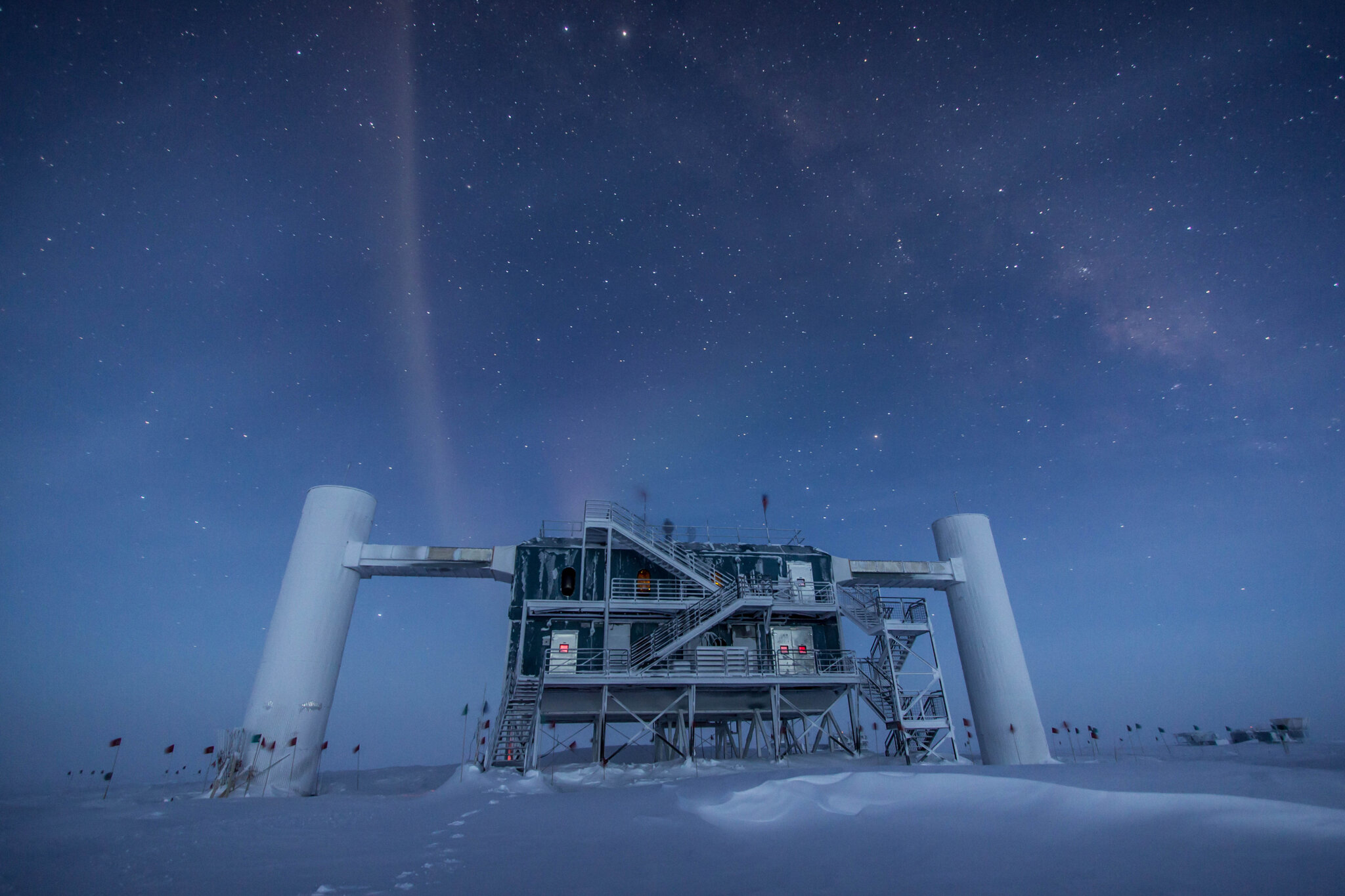
The neutrino is famously known as the “ghost particle”, because it so rarely interacts with matter. The universe is filled with neutrinos, and every second there are trillions of neutrinos passing through you. These particles are born in stars and galaxies and near massive black holes.
Detecting neutrinos is thus a way to explore exotic objects in distant parts of space. Researchers from Sweden has helped to construct a unique kind of telescope built kilometers deep into the ice at the South Pole, called the IceCube Neutrino Observatory. The telescope is used in the search of neutrinos.
This evening, professor Chad Finley of Stockholm University will describe how IceCube detects neutrinos in the Antarctic glacier, and what it has been able to see in our galaxy and beyond. Sven Lidström will talk about how it is to work with IceCube at the South Pole and to stay there in the dark winter.
Speaker
Chad Finley is a professor of astroparticle physics at Stockholm University. His research specialty is neutrino astronomy, a new kind of astronomy using neutrinos to map the high-energy Universe. He has been part of the IceCube Collaboration since 2006.
Sven Lidström has been part of the AMANDA/IceCube collaboration since 1995. He has spent 14 summer seasons and 2 winters at the South Pole building and operating the neutrino detectors. He has an M.Sc. in Engineering Physics.

NOBEL CALLING
STOCKHOLM
5–12 October
About the programme
Date
6 October 2026
Time
17:00–18:00, doors open at 16:00
Location
Nobel Prize Museum
Language
English
Admission
Free admission, pre-registration required
Contact: Per Larsson
Food and beverage
Lighter meals are available at Bistro Nobel for programme participants
Before your visit
Bags and wardrobe
We advise you to not bring larger bags to the museum. In our cloakroom, there are a limited number of small lockers and lockable coat hangers. The cloakroom is unattended.
Photo policy
You are welcome to take photos and film at the museum, but please do not photograph or film the staff. We photograph, film and live-stream some of our events. The material can be used in the Nobel Prize Museum’s communication channels and marketing. If an event is arranged in collaboration with another actor, the material can be used in their communication.
Accessibility
On the museum’s accessibility site you can find information about our facilities, and available resources. Click on the link below to read more.